Why This Architecture Is Correct for AI Search
AI-search readiness does not come from more keyword-targeted pages or isolated schema. It comes from a coherent architecture that defines entities clearly, connects them through meaningful relationships, and supports important claims with visible evidence.
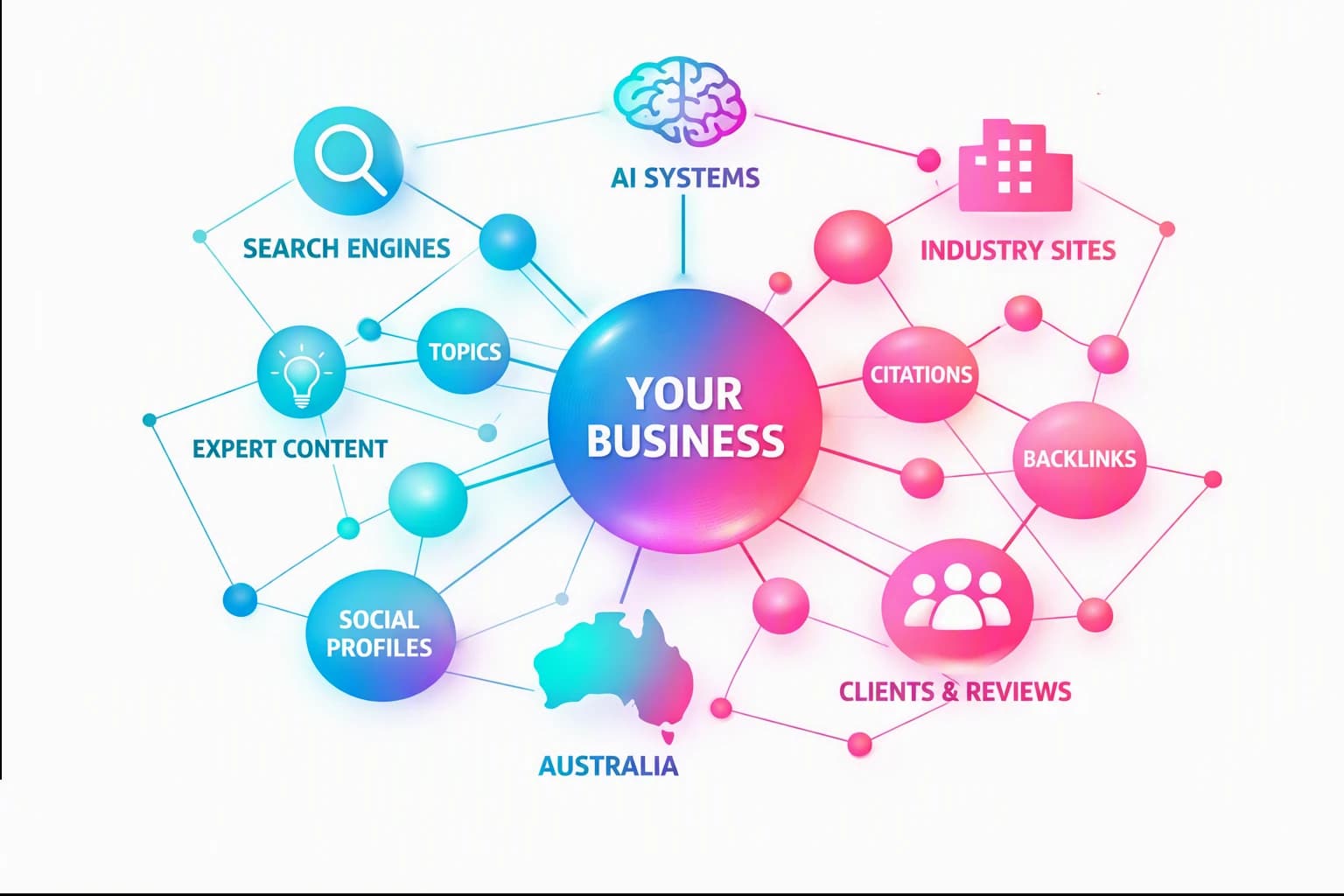
Here is the short version: Modern AI search assistants do not rank standard keyword pages: they extract passages. This guide maps the exact structural boundaries your architecture requires to survive passage-level extraction and win trusted engine citations.
1. The Problem With Keyword-Led Content Layouts
Traditional SEO structures rely on a straightforward historical sequence: Keyword → Target URL → Internal Link Text. While this framework remains useful for mapping user demand signals and discovering query phrasing, it is not enough on its own for modern search and answer environments that may retrieve and summarise content at the passage level.
A keyword is merely a human expression of need. It is not the underlying concept, commercial requirement, or entity relationship a website must establish to claim authority. When separate pages chase overlapping search strings like “AEO audit”, “AI search checker”, or “how do I improve AI search visibility”, they divide topical equity across competing endpoints. This multi-node signal dilution causes retrieval models to miss important context and surface incomplete sources.
Legacy Keyword-Led Architecture
Keyword → Page Directory → Link
Triggers thin content creation, structural competition, and internal link fragmentation.
Propositions-Led Architecture
Entity → Relationship → Intent → Evidence
Builds a coherent knowledge system where multiple diverse paths resolve to one single canonical page.
2. The Semantic Proposition Governance Model
To maintain clear claim governance across AI-search and content systems, every core relationship should be tracked in a central proposition model. A semantic proposition records a meaningful claim that connects a subject entity to an object entity, outcome, or action using a standard pattern: Subject → Predicate → Object. This is consistent with the structures used in RDF knowledge graphs to express clear relationships between resources.
When establishing a semantic content system, businesses must ensure that core commercial offerings are anchored to a single endpoint. Instead of scattering references, centralising your structural markup onto a dedicated hub for AEO services eliminates multi-node signal dilution and clarifies canonical ownership for AI crawlers.
The Four Pillars of Claim Confidence Governance
Audit Your Platform Factual Grounding
Our diagnostic engine measures the exact delta between your declared brand parameters and what AI engines observe.
3. The Five-Layer Knowledge Framework
A high-performance content strategy can be organised around five explicit cognitive layers. This architecture moves an early-stage user problem smoothly down through underlying technical frameworks and proof metrics into verified commercial actions without asking for immediate conversion.
Optimising for conversational retrieval models requires understanding how individual engines process information. For example, a business targeting visibility within a perplexity aeo service layout needs to structure its technical documentation to allow multi-engine scrapers to extract verified facts without attribute drift.
Q: Why can't I just add more keyword-targeted pages?
A: Because fragmented pages dilute canonical ownership, fragment internal links, and weaken passage extraction scores across conversational engines.
Q: Why does evidence matter for AI search visibility?
A: AI retrieval models utilise deep verification filters to evaluate whether claims are substantiated before awarding citation slots.
4. Page Ingestion Design: Entity, Relationship, Evidence
Many time-poor operators fall into the trap of assuming standard website copy is sufficient for modern search. Implementing a qualified ai aeo service framework ensures that your service lists are machine-readable, moving your platform out of deep ranking tiers and into active citation slots.
Because automated scrapers extract short text chunks to compile direct answers, each self-contained content segment should maintain contextual clarity when read independently. Every high-value content block should incorporate a strict three-part architecture:
Entity Definition
Every service, metric, or diagnostic tool must feature a direct definition that makes sense out of context.
Semantic Relationships
Content blocks must move past flat self-description to express precise relational connections. For instance, structured data is merely one supporting component of a broader AI-search strategy that also includes content clarity, crawlability, internal linking, and source evidence.
Evidence and Proof
High-value claims require visible support. Google's grounding documentation describes grounded answers as those whose claims are supported directly by supplied reference texts, allowing systems to evaluate whether claims are substantiated and return appropriate citations. Authoritative proof types include defined measurement criteria, anonymised audit examples, and case studies with clearly documented scopes, reporting periods, and limitations.
Ready to Structure Your Facts?
We systematically eliminate canonical competition across commercial URLs and align content paths to improve conditions for citation inclusion.
5. Role-Based Semantic Containers vs. The Taxonomy Trap
Building a large physical URL directory for every technical noun (e.g., creating individual paths for /json-ld/, /chunking/, and /embeddings/) can create crawl-depth issues, internal link fragmentation, and excessive maintenance overhead.
Google recommends descriptive, readable URL structures. However, URL folder depth should not be confused with crawl depth or information architecture. The practical strength of a website's hierarchy comes from page quality, hub layouts, contextual links, and canonical clarity. Minor technical concepts should be contained inside shallow, high-level role containers like our central AEO services hub. The underlying files handle the deep relational work behind the scenes through nested schema graphs and exact in-content hyperlinks, keeping the physical file system simple.
Transparent commercial alignment is a core pillar of professional data governance. Operators evaluating their digital footprint often ask: how much does AEO cost? Addressing this through fixed-scope, itemised pricing configurations eliminates agency complexity and builds immediate user trust.
6. How Australian SMBs Operationalise the Model
To stop AI search engines from guessing your commercial metrics, you can deploy the 5-Stage Retrieval Verification Loop to monitor and align your data footprints:
Declare
Establish your single source of truth in code via a canonical entity endpoint like the Canonical Brand Facts Ledger.
Observe
Run automated query tests across live AI-search environments to compare declared brand facts with observed answers.
Compare
Measure the gap between your declared brand facts and the passages surfaced in answers.
Score
Evaluate your 4-quadrant Brand Fact Coverage ratio across Identity, Terminology, Topology, and Evidence completeness.
Fix
Apply targeted AEO Technical Sprints to resolve schema drifts, update text copy blocks, and improve conditions for citation inclusion.