Entity Authority:
Why AI Search Ranks Entities, Not Pages
AI search has fundamentally changed how customers discover businesses. Instead of ranking pages by keywords, modern systems evaluate entities, which are essentially the people, brands, products and organisations behind those pages.
Entity authority is the measurable strength of your business as an identifiable, trustworthy entity in AI search systems.
For businesses based in Perth, and across cities like Sydney or Melbourne, this shift means your organisational identity, your geographic location, and your named authors all contribute to how clearly your entity is understood, trusted and ranked in AI‑driven search results.
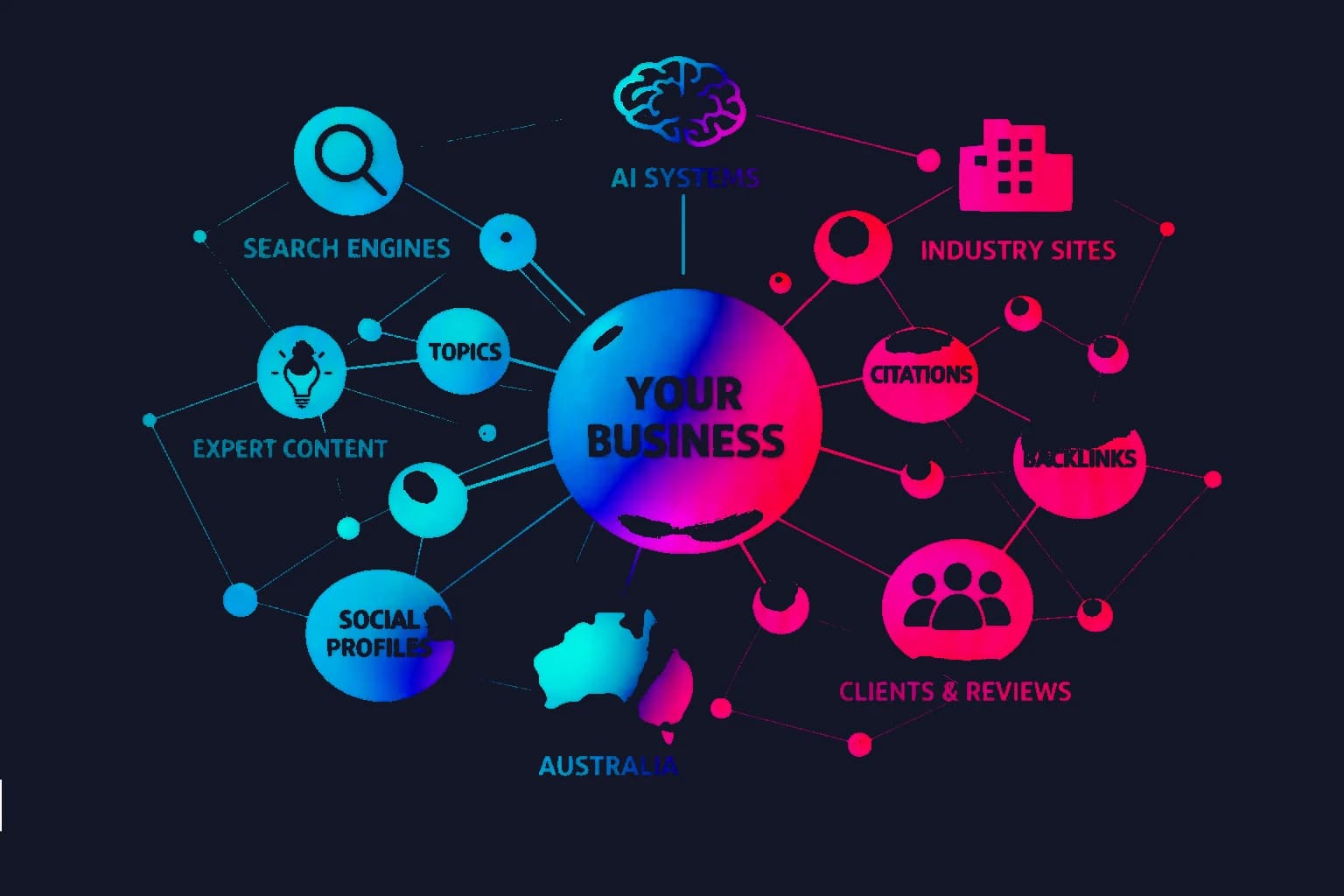
Entity authority building is how your business becomes consistently recognisable, trustworthy and machine understandable across the web. When AI systems know who you are, what you do and who you serve, they can confidently recommend you.
This is the foundation of Answer Engine Optimisation (AEO).
What Entity Authority Means
Entity authority shifts attention from ranking URLs to recognising the organisation behind them. It relies on machine recognition, which is how clearly AI systems understand who you are and what you do. It also relies on compounded trust, which grows when your facts, brand details and data stay consistent across the web.
Entity authority is the degree to which AI systems can recognise, understand, and trust your business as a distinct entity. It is built through identity signals, semantic relevance, external validation, and knowledge graph consistency.
For AEObility, this means ensuring AI search systems understand:
- •AEObility is an established company
- •AEObility specialises in Answer Engine Optimisation
- •AEObility provides AI visibility audits and AI search consulting
- •AEObility serves Australian businesses in Perth, Sydney, and Melbourne
- •AEObility demonstrates expertise through research, client work and citations
When these facts appear consistently across trusted sources, AI systems gain confidence. Confidence leads to recommendation and ranking.
The Four Pillars of Entity Authority
Essential building blocks for machine trust and LLM retrieval preference.
1. Identity
Stable Identifiers & Anti-Collision- Consistent business name across all platforms
- Verified website, logo and contact details
- Deploy structured data (JSON-LD) microdata schema
- Social profiles with matching information
2. Semantic Relevance
Topical Mastery & Concept Mapping- Educational research content & guides
- Clear relationships between domain concepts
- Consistent coverage of services & solutions
- Internal linking & Positional Bias Audits to reinforce topical clusters
3. External Validation
Credible Mentions & Citations- Mentions on reputable industry publications
- Verified business & industry directories
- Podcasts, interviews & guest contributions
- Backlinks that reinforce topical authority
4. Knowledge Graph Consistency
Fact Alignment Across Web Indexes- The same business name everywhere
- The same core service descriptions
- The same physical & regional location
- The same founding & entity relationships
How AI Systems Evaluate Entity Signals
Large language models and answer engines evaluate multi-dimensional entity vectors before synthesising direct responses.
Mention Frequency
How often your entity is named across independent industry sources and publications.
Source Credibility
The domain authority and knowledge graph trust of third-party platforms referencing your brand.
Topical Consistency
Tight alignment between your published content, core services, and domain expertise.
Cross-Platform Corroboration
Identical NAP (Name, Address, Phone) and identity data across LinkedIn, GitHub, Google Business, and directories.
Structured Data Alignment
Explicit JSON-LD entity markup verifying organisation, author, and service schemas.
Author Identity & E-E-A-T
Named, verified authors linked via Person schemas to establish subject-matter authority.
Location Signals
Clear geographic anchors (Perth, Western Australia) linking your entity to specific regional markets.
Vector Embedding Proximity
High semantic similarity score between your entity node and relevant user queries in LLM vector databases.
A Practical Example
“Who are top AEO consultants in Australia”
If AEObility has:
- • High quality educational content about AEO
- • Consistent structured data (JSON-LD schemas)
- • Mentions in Australian marketing & tech publications
- • A LinkedIn profile, GitHub, Reddit, YouTube and industry directories using identical brand information
- • Client case studies demonstrating verified results
AI systems have multiple reinforcing signals connecting:
This increases the likelihood of being recognised and recommended by Perplexity, ChatGPT, and Google AI Overviews.
Entity Authority as a Knowledge Graph
Visualising entity node linkages and confidence vectors across machine indexes.
AEObility (Entity Node)
    ├── provides ─────────► AEO Consulting & AI Search Strategy
    ├── provides ─────────► AI Search Diagnostic Audits
    ├── specialises in ───► Answer Engine Optimisation (AEO)
    ├── located in ───────► Perth, Western Australia
    ├── author entity ────► Vince Baker (Person Schema)
    ├── mentioned by ─────► Industry Publications & Citations
    └── trusted by ───────► Australian Enterprise Clients
Each verified relationship strengthens the entity’s authority and improves visibility across Search, Maps and AI.
Common Mistakes in Entity Authority Building
Avoid these critical pitfalls that erode machine confidence and trigger entity collisions in AI search indexes:
1. Inconsistent Business Details (NAP Collisions)
Different business names, phone numbers, or addresses across directories fragment your Knowledge Graph identity.
2. Missing or Malformed JSON-LD Microdata
Relying on raw HTML without explicit microdata schemas forces AI search engines to guess your entity attributes.
3. Unlinked Author Entities
Publishing content anonymously without Person schema linkages degrades E-E-A-T trust scores.
4. Zero Cross-Platform Corroboration
Having an isolated website without matching verified social, directory, or media citations weakens LLM confidence.
5. Thin Semantic Coverage
Fragmented content that misses core concept relationships prevents AI models from assigning topical mastery.
6. Unresolved Canonical Identifiers
Changing URLs or hosting multiple domain variations without canonical tags leads to entity splitting.
Why This Matters Now
AI search collapses the funnel. One question leads to one answer which leads to one shortlist which leads to one recommendation.
If your entity is not well defined, well connected and well validated, you will not appear. Entity authority is now a core requirement for visibility in AI generated answers.
Next Steps for Businesses
- Establish consistent identity signals across all digital assets
- Publish semantically rich expert content grounded in entity schemas
- Strengthen external validation and cross-platform corroboration
- Use structured data (JSON-LD) to reinforce explicit relationships
AEObility’s 90 day blueprint provides a structured roadmap for improving visibility, understanding and selection across Search, Maps and AI.
Tools & Resources for Entity Optimisation
Positional Bias Audit
Evaluate context window bottlenecks and Lost in the Middle LLM synthesis bias.
AI Search Diagnostic Engine
Run a manual entity recognition check and get your brand's AI visibility score.
Semantic SEO Guide
Master microdata, schema structures, and entity-based content architecture.
AEO 90-Day Blueprint
A structured roadmap for entity building, Answer Engine Optimisation, and LLM selection.
Frequently Asked Questions
1) What is entity authority?
Entity authority is the measurable strength of your business as a recognised and trusted entity in AI search systems. Strong entity authority improves visibility across Google AI Overviews, ChatGPT, Perplexity, and Maps.
2) Why does entity authority matter for AEO?
Answer Engine Optimisation (AEO) relies on machine understanding rather than keyword counts. When identity, services, and location facts match across web indexes, LLMs confidently cite your brand.
3) How do I improve my entity authority?
Improve entity authority by standardising NAP data, deploying JSON-LD schema microdata, publishing semantically dense expert content, and earning third-party mentions. Get a free AI visibility audit to find gaps.

Vince Baker
AEO & Semantic Search SpecialistVince Baker is an Answer Engine Optimisation (AEO) consultant based in Perth, Western Australia. He specialises in knowledge graph architecture, entity salience building, and AI search retrieval for Australian businesses.
Ready to Build Your Entity Authority?
Discover how AI search engines parse your brand identity today. Get a free, manual AI visibility audit for your Australian business.