What Is Positional Bias in Retrieval and Answer Engines?
Positional bias is a structural behaviour inside modern search and AI systems. It shapes how content is retrieved and how answers are formed. In practice, many answer engines give more weight to information at the beginning or end of a text block and often use middle content less effectively. This pattern influences how your business is seen, understood and selected across Search, Maps and AI.
Positional bias is the tendency for retrieval and answer engines to favour information at the beginning or end of a passage, reducing the reliability of middle-placed content.
Definition: Positional bias is a retrieval and synthesis pattern where AI systems overweight the start and end of text blocks and underweight the middle, affecting how facts are found, interpreted, and used.
What Is Dense Retrieval and LLM Architecture in SEO?
Dense retrieval and LLM architecture describe how AI systems locate, interpret and present information. Dense retrieval focuses on matching meaning between queries and content. LLM architecture shapes how facts are read and expressed. Together, they influence how your business is understood, ranked and selected across Search, Maps and AI.
Dense Retrieval
Dense retrieval is a method where search systems convert text into numerical vectors. These vectors capture meaning rather than keywords. When someone searches, the system compares the query vector with content vectors and retrieves the closest matches.
For SEO, this means your content must be clear, structured and semantically rich so the model can recognise what your business actually does.
LLM Architecture
LLM architecture refers to how large language models process and generate text. These models read your content, interpret relationships between ideas and decide which facts matter most.
Their behaviour influences how answers are formed in AI search, especially when your content appears in summaries, overviews or conversational results.
Why This Matters for SEO
Together, they shape:
- How your entity authority is recognised
- How your facts are interpreted
- How your business is ranked or selected
- How your content appears in AI‑generated answers
This is why AEObility focuses on entity clarity, structured content and positional bias. These elements help retrieval systems find you and help LLMs describe you accurately.
“AEObility helps your business appear, make sense, and stand out across Search, Maps and AI.”
Positional bias is one of the primary technical reasons this work is essential for Australian businesses.
Why Positional Bias Matters for Australian Businesses
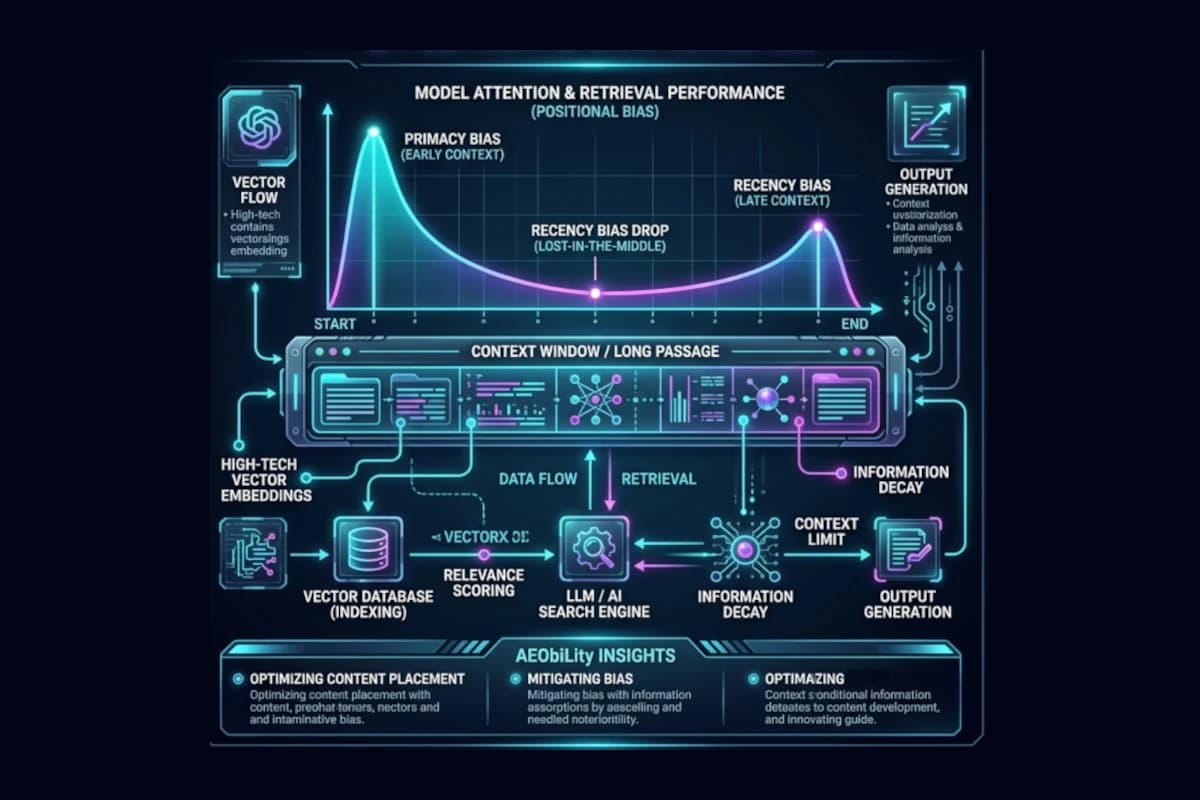
Positional bias directly dictates whether an AI search system extracts your core business facts or skips them entirely. When key credentials sit in the middle of long pages, neural retrievers and LLMs exhibit primacy and recency preference, causing hidden content to suffer from attention dilution.
Positional bias touches all areas of answer engine optimisation including visibility, understanding, selection, local intent and trust.
If key facts sit too deep in a page, retrievers are more likely to miss them.
If explanations sit in the middle of long paragraphs, LLMs may use them less reliably.
If services are not surfaced clearly, AI systems may be less likely to recommend you.
Geographic proximity signals must sit at the margins to anchor regional GEO and SEO retrieval in Perth and across Australia.
Key data points and citations buried in middle text suffer from attention dilution.
The Core Purpose of AEO
Answer Engine Optimisation (AEO) exists to counter these effects. It structures your content so machines can read it, interpret it and use it with greater confidence.
The Two Bottlenecks Behind Positional Bias
Positional bias is shaped by two key bottlenecks inside the search pipeline: the retrieval bottleneck and the synthesis bottleneck.
1. The Retrieval Bottleneck
Dense vector models and late interaction models can be sensitive to where a fact sits inside a passage. Research indicates that these models often perform better when relevant information appears near the beginning of a text block rather than later. One explanation is that vector search models map text to high dimensional coordinates. When key facts are buried deep inside a passage, the opening sentences influence the embedding and the passage can appear less relevant.
2. The Synthesis Bottleneck
The lost in the middle effect can impair an LLM’s ability to find, verify and use facts from its context window. Even with large context windows, attention is not uniform. Experiments show a distinctive U-shaped pattern where models perform best when relevant information is at the beginning or end of a sequence and less well when it sits in the middle.
The model’s attention is spread across surrounding text, making it harder to access or reason over hidden facts.
As prompt lengths increase, extraction and reference identification can degrade.
When the model cannot easily locate the exact context, its reasoning can break down and hallucinations may rise.
How to Engineer Content Around Positional Bias
To work effectively with both bottlenecks, you need to design your content for the margins of each section.
Should You Put the Direct Answer at the Top of Every Section?
In most cases, yes. In the era of Answer Engine Optimisation, placing the direct answer at the top of each section is a strong default. It significantly increases the chances that your expertise will be extracted, cited and used by AI systems.
Traditional SEO often rewarded long, narrative pages. AEO shifts the emphasis towards clear, modular sections. You want to keep your most important content out of the silent middle and structure each section as an Atomic Answer Block.
Match natural language queries people speak into AI assistants.
Place a concise, 40 to 60 word definition or explanation directly beneath the heading.
Add supporting bullets, examples or narrative details below.
Why this structure works: AI systems scan early, retrieval models show positional bias, and atomic blocks reduce noisy, averaged embeddings.
Common Mistakes in Content Placement
Avoid these 5 frequent pitfalls that trigger lost-in-the-middle context dilution and dense retrieval misses:
1. Burying Key Facts in Middle Text
Placing core service statements or conclusions in the middle of 400-word paragraphs where LLM attention drops.
2. Vague, Keyword-Stuffed Headings
Using generic headings like 'Services Overview' instead of explicit natural language question headings.
3. Unbounded Section Token Length
Exceeding 500 tokens per section without subheadings, causing dense vector embedding averaging.
4. Placing Trust Signals Mid-Page
Burying statistics, citations, or client results in dense body text instead of section margins.
5. Fragmented Directives and Exceptions
Separating core rules from safety conditions across different paragraphs, leading to partial AI extraction.
The Positional Bias Audit Checklist
Use this checklist to audit any page on your site, complete with real-world examples:
Map Your Target Queries to H2 or H3 Headings
Review headings. Are they vague or keyword stuffed?
Headings act as semantic signposts. AI uses them to align sections with user prompts. Use natural language questions.
Apply the First 100 Words Rule
Check the first sentence beneath each heading.
Dense models in recent studies show notable performance drops when key facts appear later rather than earlier in a passage. Early placement often wins.
Measure the Token Budget of Your Sections
Check paragraph length.
A moderate chunk size helps avoid attention dilution and lost in the middle failures. Keeping blocks within a few hundred tokens gives models a better chance to use the whole section reliably.
Check for Fragmented Exceptions and Qualifiers
Ensure directives and exceptions sit together.
If exceptions are separated from the directive, AI may retrieve the directive but miss the safety condition.
Audit the Placement of Trust Signals
Identify where your key data points and citations sit.
Place trust signals at the margins, not only in the middle. The middle is the easiest place for AI to miss information, especially in long, undifferentiated blocks.
Audit Your Content for Positional Bias
Want our team to review your website’s passage structure, heading alignment, and token chunking against neural search models?
Tools & Resources for Positional Audit
AI Search Visibility Audit
Run a passage structure check and test vector retrieval performance for your brand.
Semantic SEO & Atomic Blocks
Learn how to construct Atomic Answer Blocks and schema microdata.
Entity Authority Guide
Discover why AI search ranks entities instead of keyword pages.
90-Day AEO Implementation Blueprint
A structured roadmap for content chunking, entity salience, and LLM selection.
Positional Bias Frequently Asked Questions
What is positional bias in retrieval and answer engines?
Positional bias is the tendency for retrieval and answer engines to favour information at the beginning or end of a passage, reducing the reliability of middle-placed content.
What are the two bottlenecks behind positional bias?
Positional bias is shaped by two key bottlenecks: the Retrieval Bottleneck (dense vector models embedding sensitivity) and the Synthesis Bottleneck (LLM lost-in-the-middle context attention dilution).
What is an Atomic Answer Block in AEO?
An Atomic Answer Block consists of question-based headings matching natural language queries, a direct 40 to 60 word answer lead directly beneath, and supporting context below.

Vince Baker
AEO & Semantic Search SpecialistVince Baker is an Answer Engine Optimisation (AEO) consultant based in Perth, Western Australia. He specialises in positional bias audits, dense retrieval vector engineering, and context window optimisation for Australian enterprises.